
Progressive Lenses and Dizziness: Could Your Patient’s Glasses Be Affecting Their Balance?

A 72-year-old patient comes to see you because she continues to feel unsteady despite recovering well from a vestibular disorder. Her vestibular examination is improving. Her strength is good. She walks reasonably well in the clinic.
But she tells you something interesting:
“I feel much worse in the grocery store, when I turn my head while walking, and especially when I look down going downstairs.”
We often think about the vestibular, neurological and musculoskeletal reasons for these symptoms. But there is another question worth asking:
What type of glasses is she wearing?
For patients experiencing dizziness, imbalance or motion sensitivity, progressive lenses may be an overlooked factor. Their optical characteristics can affect head movement, peripheral vision, optic flow and how someone sees the ground while walking.
For a healthy visual-vestibular system, these effects are usually well tolerated. For someone already struggling to process visual and vestibular information, they may matter considerably more.
Understanding the Progressive Lens “Corridor”
Progressive lenses don't provide equally clear vision across the entire lens. Instead, the usable area of clearer vision changes as you move from the top to the bottom of the lens.
The upper portion provides a relatively broad area for distance vision. Moving downward, this narrows into a central corridor used for intermediate distances before transitioning into the near-vision zone toward the bottom of the lens. On either side of this central corridor are areas of increasing unwanted astigmatism, blur and spatial distortion. [1]
You can think of the clearer usable areas as roughly hourglass-shaped, although the exact size and shape vary considerably between progressive-lens designs.
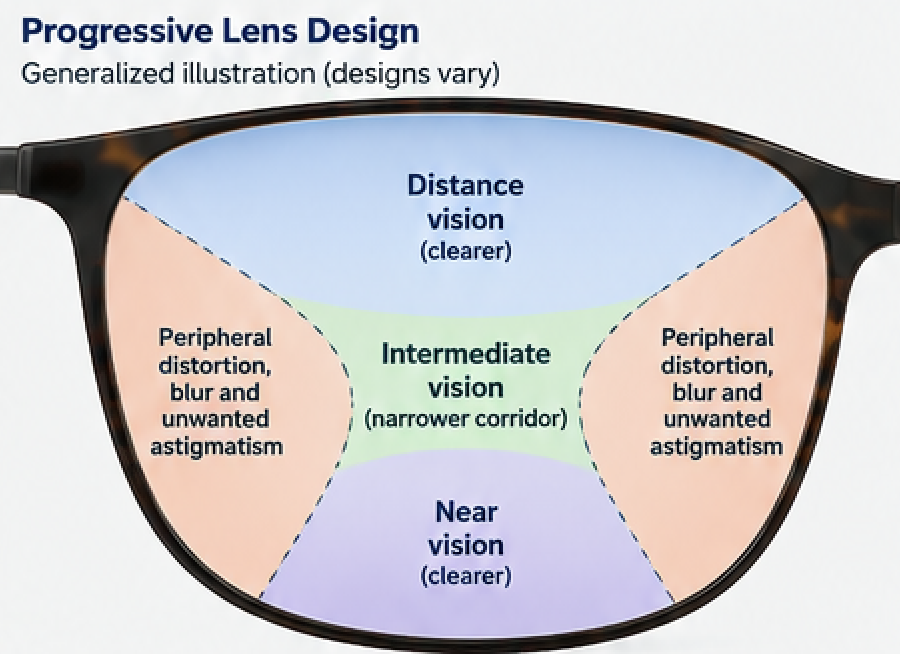
This has an important functional consequence.
Looking farther to the side by moving only the eyes may take the wearer out of the clearer central area and into greater peripheral distortion. As a result, progressive-lens wearers may use more head movement to bring what they want to see into the clearer portion of the lens. Reviews of presbyopic spectacle correction describe the coordinated eye, head and body movements involved in using progressive lenses. [2]
For most people this becomes automatic.
For someone with a vestibular disorder, however, those additional head movements may provoke the very symptoms for which they are seeking treatment.
Progressive Lenses, Head Movement and Optic Flow
I was already familiar with the peripheral distortion created by progressive lenses. What I hadn't appreciated until looking more closely at the research was how that distortion can affect optic flow.
So, what exactly is optic flow?
When we move through our environment, images move across the retina in a predictable pattern. Imagine walking straight down a hallway: objects directly ahead change relatively little, while the walls, floor and objects beside us appear to move past us increasingly quickly.
This pattern of visual motion is called optic flow, and our brain uses it as an important source of information about the direction and speed of our own movement.
This becomes particularly interesting when we consider progressive lenses.
Sauer and colleagues investigated this using simulated progressive-lens distortion. They found that distortion in the peripheral portions of the lens altered optic-flow information enough to produce measurable errors in perceived direction of self-motion. In other words, the visual information reaching the brain could suggest that the person was moving in a slightly different direction than they actually were. [3]
Other research has examined the familiar “swim effect” associated with progressive lenses, where lens distortion during head movement can make the visual environment appear to move or distort unnaturally. [4]
That caught my attention as a vestibular therapist.
Consider the patient who already tells you:
-
“The grocery store makes me dizzy.”
-
“Things move when I turn my head.”
-
“I feel off when I'm walking.”
-
“Looking down makes me unsteady.”
-
“Busy environments bother me.”
Their progressive lenses didn't necessarily cause their vestibular problem. But the lenses may be introducing another source of altered visual information into a system that is already having difficulty reconciling visual, vestibular and somatosensory inputs.
Clinically, that creates an interesting combination:
more head movement + distorted peripheral optic flow + an already challenged visual-vestibular system.
But What If the Patient Has Worn Progressive Lenses for Years?
This raises another question.
What about the patient who has worn progressive lenses successfully for five or ten years and never experienced dizziness from them?
The brain clearly has an impressive ability to adapt to progressive lenses. Research demonstrates that exposure to progressive-lens blur can alter perceptual sensitivity, providing evidence that the visual system adapts to some of the optical characteristics of progressive lenses. [5]
But could a new vestibular disorder change that equation?
This is where we need to distinguish established evidence from a clinically plausible hypothesis.
Following vestibular injury, the central nervous system must recalibrate how it uses vestibular, visual and somatosensory information. Vestibular compensation involves neural plasticity and sensory reweighting, and some patients become more reliant on vision when vestibular information becomes less reliable. [6,7]
So perhaps the question isn't simply:
“Has this patient adapted to their progressive lenses?”
It might also be:
“Does their newly challenged visual-vestibular system tolerate those same optical distortions as well as it did before?”
I sometimes think of this clinically as the brain having a certain amount of buffering capacity.
We see analogous situations elsewhere: something that was previously well compensated may become symptomatic when additional demands are placed on the system.
We don't currently have evidence demonstrating that a vestibular injury specifically causes someone to lose their adaptation to progressive lenses. So this remains a clinical hypothesis rather than an established mechanism.
But the sensory context has clearly changed.
A brain that is now recalibrating vestibular function and reweighting visual, vestibular and somatosensory information may conceivably have more difficulty accommodating optical distortion that previously went unnoticed.
Or put more simply:
The glasses haven't changed. The sensory system trying to compensate for them has.
That gives us another useful question:
“You've worn these glasses for years, but did they start bothering you differently after your dizziness began?”
Progressive Lenses, Bifocals, Stairs and Fall Risk
There is another issue that has less to do with dizziness and more to do with balance and falls.
When we walk downstairs, step off a curb or negotiate uneven terrain, we rely heavily on our lower visual field to determine where our feet and the walking surface are located.
But what portion of a multifocal lens are we looking through when we look down?
The near-vision portion.
That part of the lens is designed to bring something approximately reading distance into focus, not a stair several feet away.
Importantly, this issue is not unique to progressive lenses.
Research has demonstrated that multifocal glasses, including bifocals and progressive lenses, can reduce edge-contrast sensitivity and depth perception when distant objects are viewed through the lower, near-vision portion of the lens. In a prospective study of 156 older adults, regular multifocal wearers were more than twice as likely to fall as non-multifocal wearers after adjustment for other fall-risk factors. Falls involving trips, outdoor walking and stairs were particularly increased. [8]
Laboratory studies have similarly found improvements in stepping and landing control when habitual multifocal wearers negotiate changes in surface height using single-vision distance glasses. [9,10]
For a healthcare provider treating an older patient with both dizziness and increased fall risk, eyewear deserves a place in the assessment.
Bifocals vs. Progressive Lenses for Dizziness: Is One Better?
Bifocals have their own optical disadvantage. Crossing the visible line between distance and near correction can produce an image jump, an abrupt apparent displacement of the image.
Progressive lenses avoid that abrupt transition by gradually changing optical power through the lens. However, they introduce a different issue: lateral distortion associated with the progressive corridor. [1]
A 2025 secondary analysis of the VISIBLE trial found that, after adjusting for established fall-risk factors, progressive-lens wearers had more than twice the odds of experiencing multiple falls compared with bifocal wearers (OR 2.23; 95% CI 1.08–4.58). [11]
So the answer isn't simply that bifocals are “better.”
A lined bifocal has a more predictable distance zone and avoids some of the lateral distortion associated with progressive lenses, but introduces an optical transition and image jump.
Progressive lenses eliminate the line and provide intermediate correction but require the wearer to navigate different optical zones and peripheral distortion.
For a patient with significant dizziness, visual motion sensitivity or imbalance, those differences may be clinically relevant.
Are Single-Vision Distance Glasses Better for Balance?
For selected patients, single-vision distance glasses may be worth discussing.
They provide consistent distance correction across essentially the entire lens. When someone looks toward the floor, stairs or an obstacle, they continue looking through their distance prescription rather than through a near-vision zone.
The VISIBLE randomized controlled trial studied 606 older multifocal wearers at increased risk of falling. Providing single-vision distance glasses for walking and outdoor activities did not significantly reduce falls across the entire group. However, among participants who regularly participated in outdoor activities, falls were substantially reduced. Interestingly, less-active participants experienced more outdoor falls, emphasizing the importance of adaptation and individualized recommendations. [12]
There is therefore no justification for telling every dizzy patient to abandon their progressive lenses.
Instead, eyewear should become another variable we consider during a dizziness and balance assessment.
Five Questions to Ask Patients With Dizziness Who Wear Glasses
Adding a few questions to your subjective assessment takes less than a minute:
1. What type of glasses do you wear?
Single vision, bifocals, trifocals or progressive lenses?
2. How long have you worn them?
Someone well adapted to the same progressive lenses for years is different from someone who received their first pair two weeks ago.
3. Did your glasses or prescription change around the time your dizziness changed?
4. Are you worse looking down, walking, using stairs or turning your head?
5. Do you feel different walking without your progressive lenses or with an older pair of glasses?
The answers don't establish causation, but they may uncover a contributing factor that otherwise goes unnoticed.
A Simple Clinical Test for Progressive Lenses and Dizziness
There is also something we can observe in the clinic.
If a patient wearing progressive lenses reports dizziness with walking and head movement, watch how they visually explore the room.
Ask them to look at objects centrally and then progressively farther to either side.
Do they primarily move their eyes?
Or do you see obvious head movements as they attempt to bring the target into the clearer corridor of their progressive lenses?
Now consider that strategy in someone with reduced dynamic visual acuity, motion-provoked dizziness or impaired VOR function.
Their eyewear may be encouraging additional head movement while simultaneously altering peripheral optic flow during that movement.
That is an interaction we can easily overlook during a vestibular assessment.
What Should Healthcare Providers Do?
Healthcare providers involved in vestibular rehabilitation should not prescribe optical corrections; that decision belongs with the patient's optometrist, neuro-optometrist, or ophthalmologist.
But we can recognize when eyewear may be contributing to a patient's difficulties and communicate what we are observing.
For a patient with substantial dizziness, visual motion sensitivity, imbalance or fall risk, it may be worthwhile discussing with their eye-care provider whether they would benefit from:
-
Single-vision distance glasses for walking and other mobility activities, with separate reading glasses used when needed. This removes the near-vision portion and progressive-lens distortion while the patient is moving through their environment.
-
Lined bifocals rather than progressive lenses in selected patients who need one pair of glasses but appear particularly sensitive to progressive-lens distortion. Bifocals introduce their own optical challenges, including image jump, so this isn't necessarily a better option for everyone.
Importantly, I wouldn't recommend automatically changing the eyewear of someone who has worn progressive lenses successfully for years simply because they developed a vestibular disorder. Adaptation matters, and changing a familiar visual system may introduce yet another sensory challenge.
The question isn't:
“Are progressive lenses bad for people with dizziness?”
They aren't.
A better clinical question is:
“Could this patient's eyewear be increasing the visual and balance demands their brain is already struggling to manage?”
For some patients, the answer may be yes.
And sometimes a valuable addition to our dizziness assessment may be as simple as asking:
“Tell me about your glasses.”
References
Author

Kregg Ochitwa
Physical Therapist I Vestibular Therapist I Clinic Owner
Categories
All Categories